Insights
Why A Social-First Strategy For Branding Is Not A Bad Idea


Contents
No Time to Read It All?
Use our AI tool to get an instant, bite-sized summary of this article in seconds.
Social has always had a seat at the digital strategy table, but lately, the tables have turned. What was once a supporting channel for performance and awareness is now the main character on how brands are built, discovered, and remembered.
That approach worked when media was linear and attention predictable. But digital rewired how we consume, and social sealed the deal.
Today, audiences spend three times longer on TikTok and YouTube than on broadcast TV. The gravitational pull has shifted, from programmed viewing to algorithmic discovery, where attention isn’t bought, it’s earned.
And here’s the twist: the passive brand era is over. People don’t just consume; they comment, remix, and expect brands to participate. They want interaction, not interruption. That’s not just Gen Z behavior, that’s the modern attention economy.
The feed isn’t just the new shop window, it’s the new brand playground.
Social-first isn’t the default playbook, but it’s the one future-facing brands are quietly winning with, building recognition and relevance before the first euro hits paid.
What “Social-First” Really Means 🧐
Social-first marketing isn’t just “posting more often.” It means social sits at the center of your go-to-market strategy, the heartbeat, not the afterthought.
In this model, social intelligence guides everything: creative direction, campaign optimization, even product decisions. Your content isn’t a broadcast; it’s platform-native, community-driven, and built for dialogue.
The payoff? Every insight, comment, and engagement loop feeds back into smarter marketing, sharper service, and faster growth. Because when you build around social not just on top of it, you stop chasing relevance and start leading it.
My Numbers Don’t Lie 💃
If you’re still wondering whether “social-first” is just another marketing buzzword, the data says otherwise.
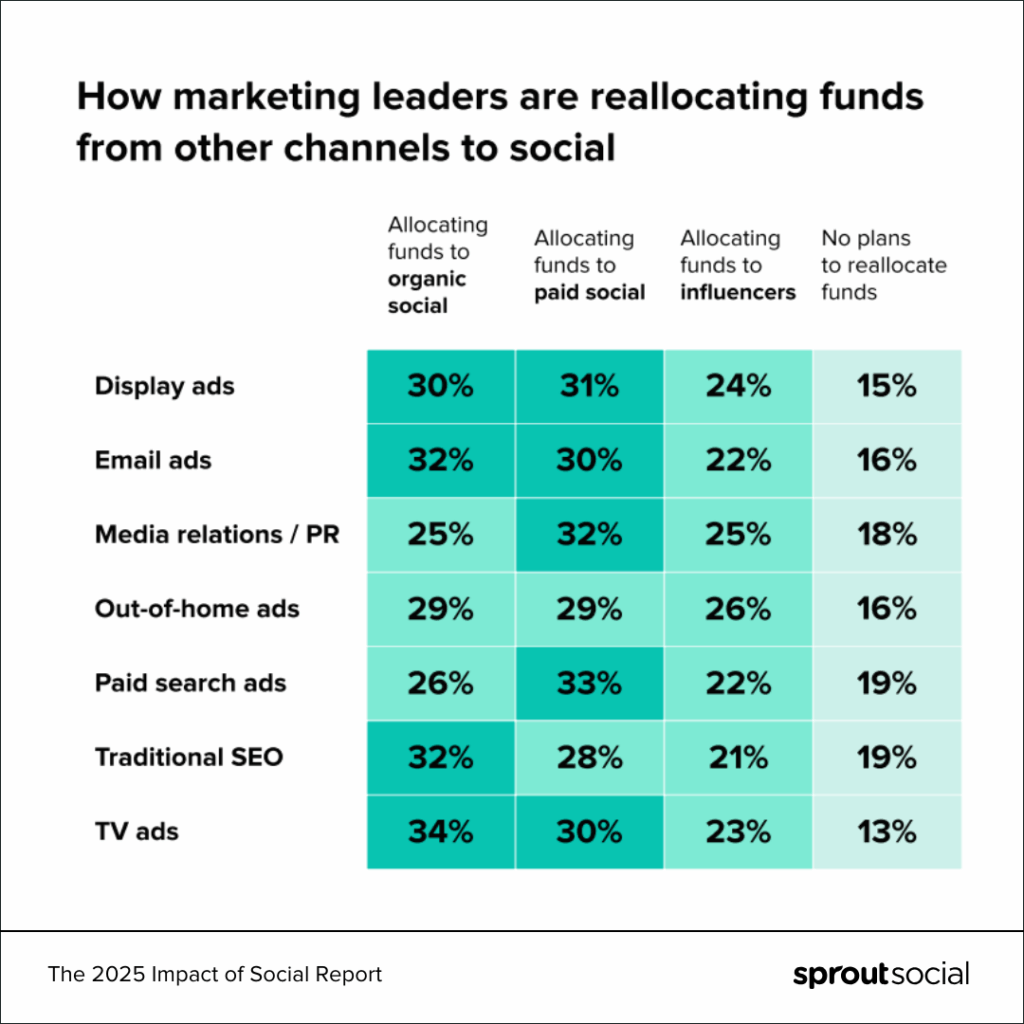
Budgets are moving where audiences already are. According to the 2025 Impact of Social Media Marketing Report, 87% of marketing leaders plan to increase their paid social investment, while over 80% are boosting influencer and organic social spend. That’s not a tweak, it’s a transformation.
Why? Because attention has officially gone mobile, conversational, and algorithm-fed. The feed isn’t just where people scroll, it’s where they shop, trust, and decide.
And the smart brands? They’re not waiting for the curve to flatten, they’re already building brand equity where discovery happens first.
🧑🏫 Proving the Power of Social-First Marketing
With budgets shifting to social, every marketing leader is now living under the same spotlight: show the ROI or lose the buy-in.
The formula? It’s a two-part equation, connect social to revenue and prove internal efficiency.
Turning social into a measurable growth driver starts with real attribution. Not vanity metrics, not screenshots from Analytics, but tech that makes social a company-wide source of truth, tying discovery to purchase, content to conversions, and conversations to revenue.
But the second half of the story is just as critical: operational efficiency. According to the Impact of Social Media Marketing Report, leaders who define ROI in terms of efficiency are far more confident in proving social’s value.
That’s where AI-powered workflows change the game. Think trend detection, sentiment tracking, auto-publishing, real-time responses, influencer vetting all handled faster, smarter, and with less manual lift. When automation clears the noise, your team can focus on what actually builds brands: strategy, storytelling, and customer experience.
Because in 2025, likes don’t make the board report, impact does.
The social-first teams winning today are the ones that connect every post, comment, and creator back to either revenue growth or cost efficiency and can prove it with data that stands up in the boardroom.
Keep In Mind 🧠
Let’s be clear, the core principles of brand building haven’t gone anywhere.
Reach still matters. Consistency still builds trust. And no one’s saying to ditch your ad budget, digital or broadcast.
Paid campaigns, whether they live on Google, Meta, or prime-time TV, still play a crucial role in driving awareness and conversion. But today, they’re the supporting act, not the headliner. The real brand battleground is social, the space shaping perception, conversation, and loyalty across the entire customer journey.
The mindset shift? Build your brand strategy social-out, not media-out. Start where culture happens, inside the feeds, the comments, the DMs where creative ideas meet real audience energy. Then scale what resonates into your paid and broadcast channels.
The principles stay the same. The order of play doesn’t.
Because in 2025, the smartest brands aren’t shouting the loudest, they’re starting the conversations everyone else pays to join.
Closing Tab 🗂️
What looks like a “social-first strategy” from the outside is, nine times out of ten, just great creative finding its perfect stage. Social didn’t make it work, it amplified it.
Algorithms, formats, and fleeting trends shape how your brand shows up. But why people care? That’s still on the creative. The copywriters, strategists, and designers who give brands something worth broadcasting. Whether it’s paid or organic, the creative is the engine, social is just the loudspeaker.
So, if you’re still chasing the magic “viral” formula, stop.
There’s no shortcut to cultural relevance. Do the real work
✅ Build a brand voice that sounds human.
✅ Understand your audience beyond demographics, get into their communities.
✅ Align creative and social so one drives the idea and the other brings it to life.
✅ And trust the people who live on the platforms, the ones who get the language, humor, and rhythm of the feed.
Because the future, and let’s be honest, the present of social-first branding isn’t about chasing the algorithm, it’s about feeding it something epic.
At Ruler, that’s what we do best
We connect strategy to storytelling, and creativity to conversion.
We don’t just make content perform, we make it matter.
So if your brand’s ready to stop scrolling and start shaping culture,
you know where to find us.